

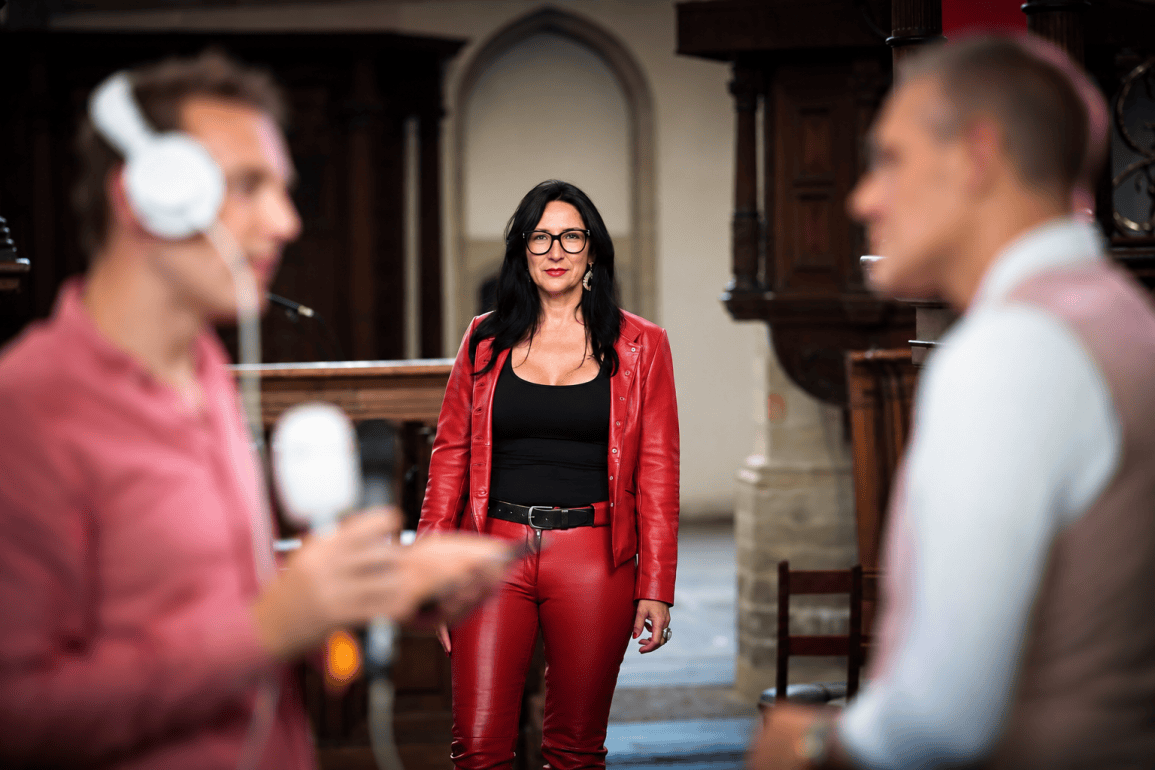
Pride Amsterdam chair, politician, photographer, fetish ambassador and so much more – Suzanne van de Laar has spent a lifetime learning that boundaries do not prevent people from growing – they create the conditions that make growth possible.
Setting Boundaries: What Is It You Don’t Want?
Suzanne van de Laar starts her summer days with her hands in the soil. Before stepping out into the world, as chair of Pride Amsterdam, D66 politician for Almere, Miss Leather Netherlands and so much more – Suzanne practices grounding with her hands in the earth. Tending to the garden with the same care she tends to her life.
In her early career as a photographer, before pulling out the camera, Suzanne would make her subject coffee.
There was a small room beside her studio where clients would sit with her before the shoot. The interaction did not start with poses or lighting. She did not pull out reference photographs and ask what clients wanted to look like. Instead, she asked a much more useful question:
“Tell me what you don’t want to do,” she remembers.
To some, it sounds almost backwards. Most creative work begins by establishing the desired outcome. What do you want? What are we making? What does success look like?
Van de Laar discovered that people often answer those questions from inside the limits of what they already know. Ask someone what kind of photograph they want and they may describe a photograph they have seen before. Ask what they do not want, and a boundary emerges and with that the opportunity for new direction.
“What is your boundary?” she says. “Because if you know the boundaries, you can go.”Once that boundary has been established, “you have a blank paper, and then you can color.”
Before becoming a photographer, Van de Laar was a hairdresser. “I come from a family of hairdressers,” she says. Her grandfather was one too.
Anyone who has spent enough time behind a salon chair understands that hairdressing is rarely only about hair. There is something about the work that tends to loosen stories in others.
“People tell you things for the first time – that they’re cheating, that they have a new relationship, that they’re pregnant, or they’re going to die or that they’re ill,” she says reflecting. “They bought a new house. They tell when they’re stressed, and they tell when they’re coming out. You know everything for the first time.”
Hairdressing and photography taught her a lot about listening, making people feel comfortable when they were vulnerable – but also about expectations and boundaries. The leather and fetish community often asks the same: “What’s the thing you don’t want? And then you can go everywhere.”
Van de Laar is careful about the way she describes those spaces because people outside them often reduce fetish culture to sex. For some people, sex is certainly part of it. For others, the attraction is precisely the opposite: a space where expectations can be negotiated clearly and touch is not assumed.
Some people, she says, “just want to feel safe in a room.”
“When someone touches you and you say ‘no,’ they don’t think it’s a problem. They offer you a drink.”
These soft skills society often categorizes as belonging to private, creative or subcultural spaces can be remarkably sophisticated forms of leadership when transplanted from one bed to another.
A boundary is not necessarily a rejection.
Once everybody knows where the fence line is, there may be acres of common ground on the other side.
That principle moves almost seamlessly from a fetish space into coalition-building, stakeholder management, organizational leadership and politics.
Van de Laar’s instinct is not to begin by asking everyone to agree. She begins by understanding the terrain.
What don’t you want? Where do I need to stop? What can we build inside the space that remains.
Always there is an aspect of consent that translates well into politics.
There is also something recognizably Dutch in the insistence on saying the difficult thing plainly.
Dutch communication is widely characterized by directness: clarity is often valued above the layers of politeness or indirect suggestion common in many other cultures. Even Amsterdam’s own guidance for internationals warns that Dutch directness can initially feel startling to people accustomed to softer forms of communication.
Van de Laar takes that cultural instinct and turns it into an ethical one.
Van de Laar wants people to “say what’s on their minds,” and “don’t say ‘yes’ if you mean ‘no.’”

A Leatherwoman In City Hall
Suzanne is not a politician who hides her connection to the leather and fetish community. It is the opposite.
All of it has been out in the open since the beginning. She has spoken publicly about sexuality and desire with her own radio show, as well as her duties as Miss Leather Netherlands 2019. Pride Amsterdam has profiled her explicitly as a pansexual leatherwoman and advocate for bringing leather out of the realm of taboo.
In most political climates, those two aspects of personality could become exclusive of each other – life experiences like Van de Laar’s might be hidden, sanitized, or weaponized by opponents.
Yet Suzanne’s queer, punk rock spirit remains even in elected office – in the face of scrutiny, she does the most radical thing possible in politics: she remains true to herself.
It hasn’t all been sunshine and roses, she has faced challenges. Van de Laar told Pride Amsterdam that she had lost photography assignments because she also photographed fetish subjects. When she first entered politics as an openly fetish-identified woman, she was bullied for it.
However in the Netherlands, there is enough social and political space for voters to know this about her and still judge her capable of governing.
Van de Laar was elected to the Almere municipal council in 2022. She was reelected in 2026, and D66 subsequently selected her to lead its five-member council group.
There was no grand reinvention into “respectable political” Suzanne.
“I’m not cancellable,” she tells Sapphic Insider. “I’m a farmer. I’m a mother. I’m a godmother… let me live my life, and I will let you live yours.”
She also believes queer people deserve more than just tolerance, but acceptance and joy. “I will be on your side,” she says. “And I will be trying to make your world happy.”
“People should have the freedom to be who they are and live their lives, as long as they respect that same freedom in others.”
There is no political power or social leverage in trying to blackmail someone who lives a life they never have been ashamed of. For queer leaders, this is a political superpower: the kind of openness that is its own strength.
Even as a child, Suzanne was the one who did not quite fit into the village where she grew up.
She describes herself then as the “ugly duck” – more interested in reading, nature and taking a boat onto the water than doing what other children expected of her. Her grandparents helped her develop an early sense of conviction that would keep resurfacing throughout her life: it was all right to be exactly who she was.
Eventually she would become fearless. At thirty, after becoming seriously ill, Suzanne experienced three strokes. Facing her own mortality wasn’t something theoretical, she was actively fighting against it every day.
She knew her life could end “in just one moment,” she says looking back. “So my fear was gone.”
“I wasn’t afraid of people anymore. I wasn’t afraid of anything.”
Her personal reinvention didn’t involve discarding her previous self. Her vitality had blossomed and evolved into a different form.
“If I’m not going to change the world a little bit,” she remembers thinking, “who else is going to do it?”
Like many organic things in life – the body breaks down, changes form, and feeds whatever grows next.
Nothing is wasted.
Even the thorns have a function. To her life, she brought a gardener’s eye: the best things don’t grow in a straight line. And the artist, fetish, and pride community leader became a politician.
The Master Gardener of the Pride Community
Suzanne’s garden is just as much a respite from public life as it is a diagram of how she chooses to navigate life and relationships. A gardener learns quickly that equality and sameness are not the answers for a truly healthy ecosystem.
Treat every plant or patch of earth identically, and many will eventually fail, rot or cease to grow anything at all.
Suzanne has little interest in pretending that every person represented by an increasingly long acronym wants the same things from community.
“We are not one community,” she says. “We are a lot of tiny communities under one umbrella.”
“Everyone needs a hive,” she describes. “and inside it, perhaps even a smaller room where they can find people with whom they feel especially safe.”
She rattles off people in her own life: trans and non-binary people, gay men, bears, twinks, lesbians, non-binary dykes.
People may share a political struggle without sharing an identity, culture, sexual life or preferred social space.
The gardener does not solve that diversity by digging everything up and planting a single crop. Some plants need more room to grow. Some plants need more water or sunlight.
During our conversation, Van de Laar described the LGBTQIA+ community as a flower.
“A flower is not made of one petal,” she said.
A rose begins small and closed, then becomes more beautiful as its petals open individually.
“And it’s got thorns,” she added, smiling. “But that’s okay.”
A garden containing only one kind of plant would be terribly boring.
Building Solidarity Without Losing What Makes Us Unique
Suzanne is deeply aware that LGBTQIA+ communities are being encouraged to turn their differences against one another.
She talks about social media, bots and attempts to push groups into conflict.
Her solution is not a forced chorus of we are all exactly the same.
It is almost the opposite.
“Keep talking.”
“Keep talking and listening to each other, but also give each other the space to keep their own space.”
For centuries, Indigenous peoples across North America have practiced forms of companion planting in which different crops are grown together because – not despite – of their differences. One of the best known examples is the Haudenosaunee Three Sisters tradition: corn, beans and squash sharing the same growing space.
Van de Laar saw this principle working in practice during the WorldPride Outbox Conference – where asexual, bisexual and various fetish communities were intentionally brought into proximity.
On the surface, it may not be easy to see what these groups have in common,“ but I know we did that on purpose,” she says. “Because these communities can experience exclusion or misunderstanding, including sometimes from within the LGBTQIA+ community.”
These groups are often bullied within the queer community, both in online and offline settings. At Outbox, they were given a safe space to share their feelings and experiences of not being considered ‘lesbian enough’, ‘gay enough’, ‘sexual enough’ without being dismissed or shamed.
Suzanne prioritized bringing them into close proximity, “what you saw happening in that group is that people were looking at each other, and realizing their experiences weren’t so different at all.”
Community does not require abolishing those teams for the sake of solidarity. It requires remembering there is a larger game being played.
“We are all in the same game,” she says. “But we have our own teams.”
An asexual community should be allowed to build spaces around asexual experience. Leather communities should be allowed to build spaces with their own norms. Lesbians, trans people, intersex people, bisexual people, elders, young people, studs, butches, and the innumerable overlapping groups should have opportunities to speak in their own voices.
Not every flower can be placed in the center of the garden at the same time. But that doesn’t mean the others have been uprooted.
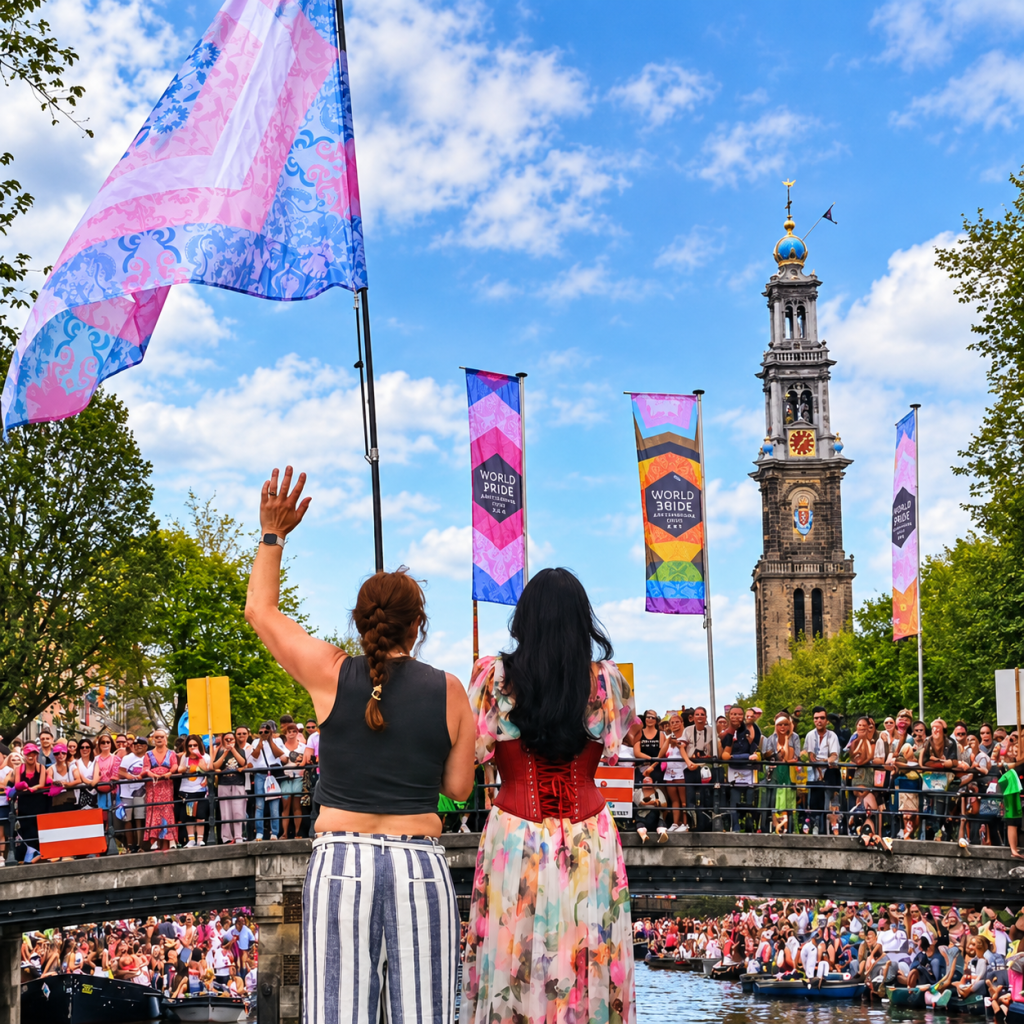
At the 2026 Pride March, she met a 68-year-old woman who told her this was the first day she had ever truly gone out into the world as herself.
They had seen Suzanne beside Queen Máxima, publicly telling people they were allowed to be who they are. And that helped them step outside late in life for their first pride experience.
“Those little things that sound so small,” Suzanne says, “are so big.”
Suzanne also describes older gay men who participated in the earliest Amsterdam Pride movement but were not the focus of the Human Rights Conference. Her message to them was not that their history no longer mattered. It was that other people needed the microphone that day.
“We are still here and we still need you,” she says. That’s why they organized Senior Pride.
“We still need every little piece with their own voice.”
For an organizer responsible for an event as enormous as Amsterdam Pride and WorldPride – it would be easy to define success through crowd size, programming, stages, sponsors and international attention.
Suzanne refuses.
“It’s not about a big Pride. Never. It’s about giving people space to be who they are.”
A master gardener does not measure the health of a garden by asking how many plants can be squeezed into it. It’s about how many varieties of plants can be healthy and thriving throughout every season, and grow again the next year.

Cultivating Leadership and Relationships with People & Institutions
When asked about juggling the relationships of her personal life with public service, Suzanne describes it “like an onion” – a direct reference to the movie Shrek she says laughing.
At the heart of her onion are her wife, her daughter and herself.
Then come godchildren and closest friends.
Then other relationships.
Activists she knows around the world have places in those circles, but not everyone is on the same layer.
This matters because grassroots community leaders are often encouraged to feign accessibility as something with limitless availability. But Suzanne does not.

Sure, her home is often open to people in her life. She can hug people, listen to them and offer them empathy and care. She loves her community, but without pretending that thousands of people belong in her innermost emotional circle.
As often with people who lead a public life, people arrive and recede, she says, “like the waves of the ocean.” Pride season brings people closer from around the world, then later they move away as another season begins.
When asked about building the kind of relationships that sustain movements, Suzanne gives sage advice, often given but rarely practiced by others.
“I love to delegate… If you want to build something, you can’t do it on your own.”
Talk to people. Find out what they are good at. Let them do it.
And accept the difficult part:
“They won’t do it the same way you do it,” she says. “Let them do it anyway.”
Suzanne does not expect delegated work to reproduce the image she had in her own head. If the result is 85% – 90% of what she imagined, she considers that excellent. Other visions are necessary.
Then she gives leadership advice everyone wants to hear from their boss:
“Don’t micromanage. Let them be.”
When people – particularly volunteers – are allowed to own their unique contribution, she believes they do better work because it becomes “their baby.”
“Give them credit for it. Say thank you.”
Leadership, in Suzanne’s formulation, depends on knowing the difference between tending and controlling.
She has no discomfort with the fact that leadership still requires authority.
“Yes, I am in control,” she says. “I am the final one making decisions. But I trust you.”
How to hold a culture of accountability and responsibility without hoarding ownership may be one of the hardest lessons a leader learns.
This same pragmatism appears when Van de Laar talks about business.
Corporate sponsorship around Pride is often treated as a binary moral test: supportive or pinkwashed? Good corporation or bad corporation?
Suzanne recognizes that maybe there are no “good” corporations, however what really matters is how queer people are treated who actually work there or who use their services.
Does a transgender employee have meaningful support during transition?
Do two mothers or two fathers both receive parental leave when having a baby?
Can LGBTQIA+ workers actually be themselves, and come as they are inside the workplace?
Those questions, she argues, tell organizers something that a rainbow logo cannot.
Another one of Van de Laar’s strengths is getting on with the work despite imperfect systems.
Her perspective does not require pretending that enormous corporations are flawless institutions. It recognizes that institutions themselves contain people that are in the LGBTQ+ community.
As someone who manages so many stakeholders, when asked for advice for small grassroots leaders looking to build something larger – Van de Laar’s philosophy of community building is quite simple.
“Ask somebody: How are you?”
Then do something unusual. Wait.
Not for the answer someone has learned will allow the conversation to move along without inconveniencing anyone.
Wait for the real answer.
There is loneliness in LGBTQIA+ communities, Van de Laar says. “There is depression.” She acknowledges, “I can’t make everyone feel safe, but I can try.”
Sometimes trying means looking another person in the eyes long enough to communicate: “I see you.”
Make time for people. Share with them love, attention, then usually they will blossom.

What the Future Holds
Ask Suzanne van de Laar what she wants five years from now and, for a woman with an impressive collection of titles, her answer is earnest:
“I just want to still be around.”
Healthy. Safe. With her wife and daughter. She wants her friends to still be around too.
She wants people to look after one another the way she saw them do during WorldPride.
Yes, she would like her political career to continue growing, so she can make a difference beyond the communities she already serves – but ambition does not appear to be the center of the picture. It is on a different layer of the onion. She speaks about the privilege of getting older.
She talks about her godchildren. Her friends becoming grandmothers.
She worries about the world that will be left around them – attacks on LGBTQIA+ rights, racism, books burned and histories erased. The hate directed at public figures who refuse to minimize who they are.
But Suzanne does not speak like someone waiting for the storm to pass.
She keeps her hands in the fertilizer, transferring the seedlings she once fostered into bigger plant beds now that they need more room for their roots to grow. Trimming. Binding. Watering. Harvesting.
She tends to the garden of the queer community every day alongside her personal garden every morning: a beautiful, messy, inspiring, community.
The master gardener’s organization does not demand that any of them be any less than who they are.
“I hope to get a lot of wrinkles from smiling,” she says.
Perhaps that is the harvest she is really working toward for all of us.