


When Mpho Tutu van Furth first became a reverend, people had questions.
Could a reverend wear stiletto heels? Could she have a tattoo? Was this really how a woman called by God was supposed to present herself?
Mpho’s answer was wonderfully uncomplicated: “God knew who I was when God called me.”
“God had not,” she joked, “intended to summon the more conventionally respectable person standing beside me – only for me to answer by accident.” There had been no divine mix-up. The stilettos, the tattoo, the personality – all of it had been present when the call was made.
There is a whole theology of sapphic self-expression inside that joke.
Bring the buzz cut, the lipstick, the work boots, the questions you were told never to ask and the love of the woman you want to hold, kiss and be with. The idea that an all-seeing, all-knowing God already sees and loves someone—but expects her to enter the sanctuary pretending to be somebody else—does not make much theological sense.
A spiritual life that is only available after you become quieter, straighter or less recognizable? Ha! To Mpho, God doesn’t require an impersonation.
She insists that the problems do not arise from a queer person or their relationship with God. The problem comes from faith communities that demand performance. For Mpho, a real faith community should be the place where a person can come before God with “the whole of you.”
That distinction may be especially freeing for sapphic women who remain curious about faith but have little interest in returning to othering or discrimination. Mpho does not ask anyone to chase acceptance from a place committed to misunderstanding them and who they are. “If a faith community makes you feel like you do not belong – then it is not your community.” Find your community elsewhere.
Tolerance Is Not the Same as Belonging
Mpho is equally clear that a rainbow flag, friendly greeting or invitation to attend does not automatically create belonging.
As she defines it, tolerance is essentially: I will put up with you. It is usually a courtesy extended by a powerful group to people who possess less power. The original hierarchy often remains intact.
You may enter the room, provided you follow rules established before you arrived. You may suggest changes, but someone else still decides whether those changes are permitted.
True belonging goes further. It means having as much right as anyone else to express yourself, shape the culture, question its assumptions and participate in its governance. You are not merely present in somebody else’s community. Your presence helps determine how the community treats people and what the community will become.
Inclusion opens doors – but true belonging happens when no one gets upset when you decide to take part in moving around the furniture.
The Tutu Legacy and a Life of Her Own
A South Africa, an Episcopal priest, theologian, author, artist and public speaker, Mpho Tutu van Furth serves as Canon for Racial Justice and Beloved Community for the Convocation of Episcopal Churches in Europe. She is also the daughter of activists Leah and the late Archbishop Desmond Tutu. Her father became one of the most visible moral leaders of the struggle against apartheid, challenging South Africa’s racist regime from the church, the streets and the international stage. His work earned him the Nobel Peace Prize in 1984.
His commitment to human dignity extended unapologetically to LGBTQ+ people. “I would refuse to go to a homophobic heaven,” he said during a UN backed human rights campaign in Cape Town in 2013. He rejected the idea of a heaven built on homophobia, making it clear he would rather be excluded from such a place than accept a distorted vision of salvation that excluded queer people.
When Mpho speaks about her parents influence, she does not describe a heavy surname or a predetermined life. She describes “a legacy of joy.” Her parents found satisfaction in work that served others, and their example encouraged her to search for the work that made her feel most alive.
Her work has included being the inaugural CEO of the Desmond & Leah Tutu Legacy Foundation, helping establish the Tutu Teach Foundation and co-authoring Made for Goodness, The Book of Forgiving,Tutu: The Authorized Portrait and Reparations: The Healing Journey.
Mpho married her Dutch partner Dr. Marceline van Furth – a professor and doctor of pediatric infectious diseases at Amsterdam University. Marceline is also an atheist – and yet her wife, intellectual sparring partner is also the co-host of their podcast, Belonging: Gender, Sex & Spirituality.
A lesbian married couple – one a Black South African, Christian reverend and the other a white, Dutch, atheist, professor – making a podcast about spirituality tells listeners something important: meaningful spiritual conversation does not require everyone at the table to reach the same conclusion.
“Our cultures are always in a process of negotiation,” Mpho says.
Marceline is very Dutch – valuing order, fairness and efficiency in institutions and believing that systems should inherently operate that way. She is sometimes quick to be frustrated when they do not.
Mpho’s life experience from a South African background, living across many countries, does not operate with an assumption that systems are innately designed to be fair or efficient.
She is more relaxed, sometimes reassuring Marceline to stay calm and let the imperfect process unfold when finding solutions, while Marceline can sometimes be the one encouraging Mpho to put on boxing gloves and demand better.
Their marriage is not a story about love magically erasing race, religion or experience. It is about two women becoming more understanding of one another, to keep learning from each other to close the distance between them so they can be together.
“What do you mean by that?” is not a thinly veiled tactic to gather intel for escalation in their marriage. It is a genuine question for resolution and compromise.
Their experience in partnership is particularly valuable in a divided world. Listening does not mean surrendering perspective. Differences do not have to become dangerous or decorative – oftentimes it’s an invitation to ask better questions.
A Podcast for Religious Curiosity
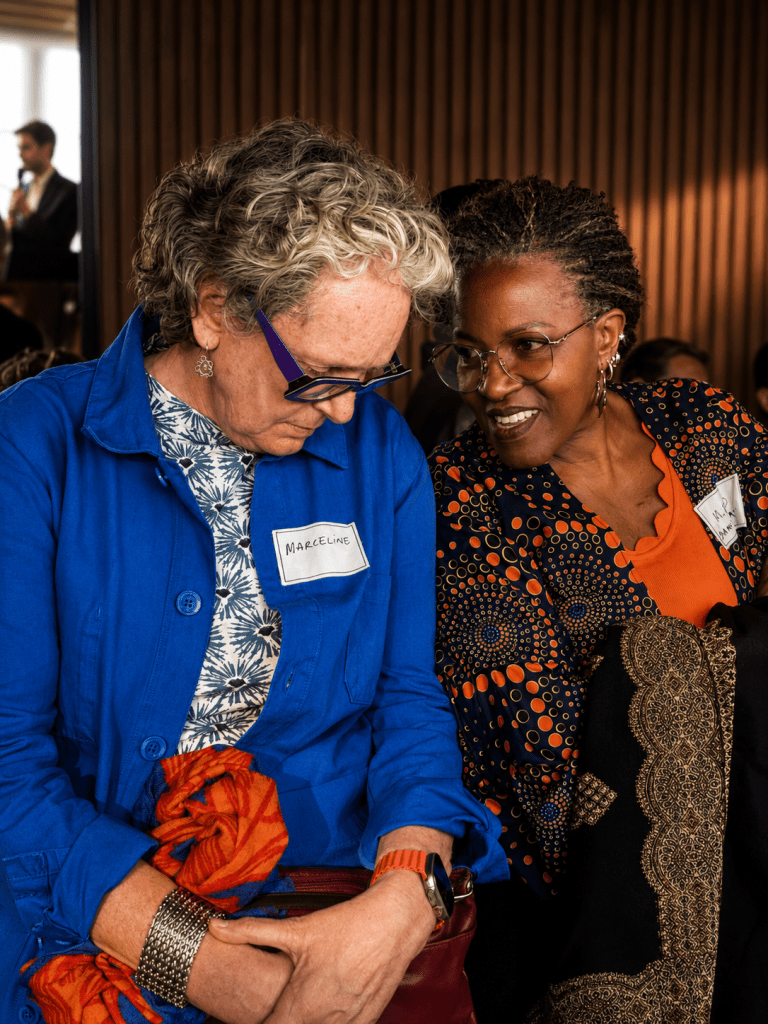
Mpho and Marceline created Belonging because they were not hearing enough respectful conversation about the places where gender, sexuality, culture and spirituality meet.
They ask the expert guests on their podcast what is actually written in religious texts, and also what various communities have layered on top of that text over centuries, shaping culture. Where does scripture end and that cultural interpretation begin? How have ideas about gender changed across religions and regions? What happens when religious identity and queer identity appear to conflict? Must they conflict at all?
“The idea was really to get to understanding one another,” Mpho explains. The goal is not to squash disagreement or politely nod through harmful ideas. It is to create conversations where guests can share ideas around faith but also can be challenged to hold a different perspective.
The guest list travels far beyond a single religion or Western understanding of gender.
South African filmmaker and human-rights activist Dr. Beverly Ditsie – the first out lesbian to address the United Nations in 1995 – examines gender fluidity, faith and the courage required to live authentically.
South African sociologist Savuka Abongile Matyila helped untangle the language of sex, gender and sexual orientation.
Buddhist scholar Thupten Jinpa – English translator to His Holiness the Dalai Lama – brought additional spiritual traditions and perspectives into their conversation, while researcher Dr. Puneet K. Bindlish explored Tritiya Prakriti—the “third nature”—and older Indian understandings of gender fluidity that complicate the claim that identities beyond the binary are modern Western inventions.
Rabbi Marianne van Praag has discussed how Jewish texts and traditions can engage contemporary understandings of gender and sexuality.
More recent guests include Kenyan feminist theologian Musimbi Kanyoro, who argues that LGBTQ+ people cannot be excluded from creation if God created all people.
The program has also announced an episode with Anglican priest, poet and transgender theologian Rachel Mann.
The range matters. Queer spirituality is often presented as one exhausted argument between conservative Christianity and LGBTQIA+ people asking to be spared. Belonging opens more doors. It brings African theology, Judaism, Buddhism, Indian spiritual traditions, feminism, sociology, activism and atheism into the same larger inquiry.
The result is not a program telling listeners what to believe. It is a program expanding the number of ideas available to them when deciding for themselves.
Queer, Lesbian, and the Culture of Belief
Mpho also offers reassurance to queer women who have been told that their sexuality conflicts with their family or culture.
Culture, she argues, is not a fixed object preserved behind glass. It is the way people live together: how they treat elders, care for children, define family and decide what matters. Those practices have always shifted through migration, contact, necessity and new understanding.
Even family language can hold more flexibility than Western categories suggest. In many cultures, someone called a sister, mother or daughter may not fit the narrow biological definition assumed by English speakers. Relationships are defined by responsibility, closeness and care as much as by a family tree.
The question is whether culture will be shaped toward fear or toward a more generous understanding of who belongs.
Mpho’s message to sapphic women building community across borders, languages, religions and political realities is immediate: “Do it.”
“It is absolutely urgent work for us,” she says. “We need to take care of each other. And the best way of taking care of ourselves is by taking care of each other.”
That care will not always be flawless. Communities become accountable by naming their values, noticing when their behavior contradicts them and returning to repair. Belonging is not achieved through perfect language or one excellent diversity statement. It is practiced in the way people keep choosing one another.
Perhaps that is what Mpho and Marceline are creating together: not a room where every person believes the same thing, but one where belief, doubt, queerness, culture and self-expression can sit beside one another without anyone being required to shrink.
A place where lesbian reverends can wear stilettos. Where atheists can hold firmly to their beliefs in conversations about spirituality without diminishing the beliefs of others around them. Where the whole of you is welcomed into the room from the start.